


The Bees of America's National Parks: Mountain, Forest and Wetlands


The Bees of America’s National Parks: Mountains, Forests & Wetlands
Part Two of the Tracy Bees National Parks Pollinator Series
America’s national parks are often celebrated for their scale.
We look toward the mountains.
We follow rivers through valleys.
We stand beneath ancient trees.
We watch fog drift across forested ridges.
We listen to waterfalls echo against stone.
We look across wetlands that seem to stretch forever.
And yet, hidden within all of that grandeur, some of the most important ecological work is being performed by creatures small enough to disappear inside a flower.
In Part Two of the Tracy Bees National Parks Pollinator Series, our journey moves away from the desert landscapes of the first collection and into a completely different set of habitats mountains, forests, meadows, river corridors, misty ridges, wetlands, and high-country environments shaped by cold, elevation, moisture, and seasonal change.
This time, we travel through four extraordinary national parks:
Yellowstone National Park
Yosemite National Park
Great Smoky Mountains National Park
Everglades National Park
Each of these parks presents pollinators with a very different world.
In Yellowstone, bees work across high-country meadows, forests, river valleys, geothermal landscapes, and short northern summers where every warm day matters.
In Yosemite, pollinators move among wildflower meadows, granite walls, waterfalls, forest openings, riverbanks, and high-elevation habitats where bloom periods can be brief but spectacular.
In Great Smoky Mountains National Park, bees inhabit one of the richest temperate forest environments in North America, surrounded by mist-covered ridges, woodland flowers, flowering shrubs, mountain streams, and layers of vegetation that change with elevation.
And in the Everglades, the entire story shifts again.
There, bees and other pollinators must navigate heat, humidity, wetlands, mangroves, tropical vegetation, seasonal flooding, and a landscape shaped by water.
Four parks.
Four ecosystems.
Four completely different expressions of pollinator life.
Yet they are all connected by the same ancient relationship between flowers and the animals that visit them.
The Small Lives Behind the Great Landscapes
When we think about national parks, our attention naturally goes to the largest features.
Mountains.
Canyons.
Forests.
Waterfalls.
Volcanoes.
Wetlands.
Wildlife.
Those things are dramatic.
They are easy to see.
Bees are different.
Their work happens quietly.
A bee lands on a flower.
It gathers nectar.
Pollen clings to the hairs on its body.
It moves to another flower.
Some of that pollen is transferred.
A plant is fertilized.
Seeds begin forming.
Those seeds may eventually become new plants.
Those plants may feed insects, birds, mammals, and other wildlife.
They may stabilize soil.
They may shade the ground.
They may create nesting material.
They may become part of a meadow, forest edge, wetland, or mountain slope.
The bee never sees most of those consequences.
It is simply gathering food.
But ecology works through connections.
One small action can become part of something much larger.
This is one of the reasons bees are such powerful teachers.
They show us how nature functions through relationships.
Not isolation.
Not one species at a time.
But networks.
There Is No Single Way to Be a Bee
One of the most fascinating things about native bees is their diversity.
People often think of bees as though they are all the same.
They are not.
Some are tiny.
Some are large.
Some are dark.
Some are metallic.
Some are striped.
Some are extremely fuzzy.
Some are almost smooth.
Some live socially.
Most native bee species are solitary.
Some nest in the ground.
Others use cavities in wood.
Some use hollow stems.
Some build partitions with mud.
Others line nest chambers with pieces of leaves.
Some carry pollen on their hind legs.
Others carry it beneath the abdomen.
Some have long tongues.
Others have short tongues.
Some can forage in cool temperatures.
Others thrive in heat.
Some visit many different kinds of flowers.
Others specialize on a narrow group of plants.
This diversity matters because different bees perform different ecological jobs.
A flower that works well for one bee may be poorly suited to another.
A cold mountain morning that prevents one species from flying may still be comfortable enough for a large bumble bee.
A deep tubular flower may reward a long-tongued bee while excluding smaller insects.
A wetland plant may attract a completely different pollinator community than an alpine meadow.
The more diverse the bee community, the more ways pollen can move.
Pollination Is Not One Event
Pollination sounds simple.
A bee visits a flower.
Pollen moves.
But the real process is much more complicated.
Timing matters.
Weather matters.
Flower shape matters.
Bee anatomy matters.
Temperature matters.
Moisture matters.
Elevation matters.
Soil matters.
Nesting habitat matters.
The availability of flowers across an entire season matters.
A bee can only pollinate if it is alive, active, and able to find suitable flowers.
A flower can only benefit if the right kind of pollinator visits at the right time.
This means pollination is not simply a moment.
It is the result of an entire system working together.
The park must provide flowers.
The bee must have somewhere to nest.
The weather must allow flight.
The plant must bloom.
The bee must emerge.
Their schedules must overlap.
And this all has to happen again the following generation.
Mountains Create Their Own Pollinator Challenges
Mountain ecosystems are especially demanding.
At higher elevations, the growing season becomes shorter.
Snow may remain on the ground late into spring.
Temperatures can fall rapidly.
Wind can become intense.
Flowers may have only a few weeks to bloom, reproduce, and set seed.
Bees living in these environments must work quickly.
Once conditions become favorable, activity can become intense.
A meadow may appear still from a distance.
But close up, it can be alive with movement.
Bumble bees push into deep flowers.
Small solitary bees move across open blossoms.
Flies hover nearby.
Butterflies travel between patches.
Beetles crawl through pollen.
Every warm hour becomes valuable.
The mountain summer is short.
Pollination cannot wait.
Why Bumble Bees Are So Important in Cool Places
Bumble bees are especially well adapted to cooler climates.
Their large, fuzzy bodies help retain heat.
Some can raise their body temperature through muscular activity.
This allows them to begin foraging when conditions are too cool for many smaller insects.
That ability becomes extremely important in mountain parks.
A cloudy morning may slow down most pollinators.
A bumble bee may keep working.
A brief warm period between storms may become an opportunity.
At high elevation, where flowering seasons are compressed, that flexibility can make a real ecological difference.
Bumble bees are also strong flyers.
They can work in windy conditions.
They can access deep flowers.
And many are capable of buzz pollination, a behavior in which they vibrate flowers to release pollen.
These abilities make them extraordinarily valuable members of mountain ecosystems.
Forests Are More Than Trees
When people think of forests, they often think of trunks and canopy.
But pollinators depend heavily on what happens below and between the trees.
Forest edges.
Meadows.
Clearings.
Riverbanks.
Burned areas.
Roadside openings.
Shrub layers.
Spring wildflowers.
These places can produce concentrated flowering resources.
A dense forest may contain relatively few blossoms in deep shade.
But a clearing can become full of flowers.
Sunlight reaches the ground.
Plants respond.
Bees follow.
This is why a healthy forest ecosystem often includes a mosaic of habitats.
Closed canopy.
Open meadow.
Wet edge.
Dry slope.
Stream corridor.
Young growth.
Mature forest.
Each one supports different plant communities.
And those plants support different pollinators.
Mist, Moisture, and Mountain Blooms
The Great Smoky Mountains offer a particularly beautiful example of how moisture shapes pollinator habitat.
Fog and rainfall support lush vegetation.
Flowering shrubs and woodland plants can thrive in environments very different from the dry West.
Different elevations create different bloom times.
A plant flowering low in the mountains may finish long before the same or similar species blooms higher up.
This creates a moving seasonal pattern.
Insects follow the flowers.
For pollinators, elevation becomes a calendar.
Blooms begin lower.
Then move upward.
The mountain becomes a sequence of feeding opportunities.
This kind of vertical seasonality is one of the most fascinating aspects of mountain ecology.
Wetlands Change Everything
Then we reach the Everglades.
And almost every assumption changes.
Instead of dry soil and rocky slopes, water becomes the organizing force.
Water controls plant communities.
Water changes access.
Water influences nesting.
Water reshapes the landscape seasonally.
Flooding and drying cycles matter.
Humidity matters.
Heat matters.
Salt exposure may matter in coastal areas.
Pollinators in wetland environments live within a system that is constantly responding to water.
Some flowering plants occur along drier margins.
Others grow near wet areas.
Mangrove communities create another set of conditions.
Tropical and subtropical plants extend bloom seasons differently from mountain environments.
The Everglades reminds us that pollinator ecology is never one-size-fits-all.
A bee surviving near an alpine meadow and a bee surviving near a wetland may share basic biology, but their lives unfold under completely different environmental pressures.
Flowers Are Designed for Interaction
Flowers are not passive objects.
Their shapes, colors, scents, textures, and rewards all influence which pollinators visit them.
Some are open and easy to access.
Others are deep and tubular.
Some offer abundant pollen.
Others provide nectar.
Some produce strong scent.
Others use visual patterns.
Bees may see ultraviolet markings invisible to human eyes.
These markings can guide them toward the center of a flower.
A flower can function almost like a landing signal.
Color.
Shape.
Scent.
Reward.
All working together.
The relationship between bees and flowers is therefore not random.
It is built through countless generations of interaction.
Pollen Is More Than Dust
To us, pollen may look like powder.
To a bee, it is food.
Pollen provides protein and other nutrients that are especially important for developing larvae.
A female bee may spend much of her adult life collecting it.
She enters a flower.
Pollen sticks to her hairs.
She grooms it.
She packs it onto specialized structures.
Then she returns to the nest.
Some of that pollen becomes food for her offspring.
But some remains on the body.
That leftover pollen may be transferred to another flower.
This is where plant reproduction and bee nutrition overlap.
The bee is feeding its young.
The plant is reproducing.
Both benefit from the same visit.
Why Bee Hair Matters
The fuzzy appearance of many bees is one of their most useful adaptations.
Bee hairs are often branched.
That structure makes them excellent at trapping pollen.
A bee pushing through a flower can become covered very quickly.
Under magnification, the result is remarkable.
Pollen grains collect across the thorax.
The legs.
The face.
The abdomen.
The underside of the body.
Different bee groups have different ways of carrying it.
Some pack pollen onto their hind legs.
Others use dense abdominal hairs.
This diversity changes the way pollen moves between flowers.
It also helps explain why native bees can be so effective.
Most Bees Do Not Live in Hives
This point is worth repeating because it changes the way we think about bee habitat.
Most native bees are solitary.
A female may create her own nest.
No queen.
No enormous workforce.
No large honey store.
She handles everything herself.
She finds a nesting site.
She gathers materials.
She collects pollen and nectar.
She prepares nest cells.
She lays eggs.
Then she seals the chambers.
For ground-nesting bees, suitable soil is essential.
For cavity nesters, hollow stems or holes in wood may be essential.
For leafcutter bees, plant material matters.
For mason bees, mud may matter.
This means bee conservation is not simply about flowers.
Food is only half the story.
Bees also need places to reproduce.
The Hidden World Beneath Our Feet
A patch of bare soil can look unimportant.
It may actually contain an entire bee community.
Ground-nesting bees can create tunnels leading to multiple brood chambers.
Some nest individually.
Others form large aggregations.
From the surface, the entrance may be tiny.
Below ground, a new generation is developing.
This hidden life is easy to damage without realizing it.
Heavy trampling.
Soil compaction.
Disturbance.
Changes in drainage.
All can affect nesting habitat.
This is one reason staying on designated trails matters.
It protects more than visible plants.
It protects the unseen ecosystem too.
Climate Controls the Calendar
Pollinators depend on timing.
If flowers bloom early and bees emerge late, the relationship can break down.
If drought reduces flowers, bees may struggle to gather enough food.
If snow melts earlier, mountain bloom periods may shift.
If wetlands dry differently, plant communities may change.
If extreme heat shortens activity windows, foraging may decline.
Climate does not affect one species at a time.
It changes schedules.
And when schedules stop matching, ecological relationships can weaken.
This is why scientists are so interested in tracking pollinators across national parks.
Protected landscapes provide valuable places to observe long-term change.
Water Can Create Pollinator Corridors
Rivers, streams, springs, and wetlands often concentrate flowers.
In dry or seasonal environments, water creates green pathways.
Plants gather near moisture.
Flowers follow.
Pollinators follow the flowers.
This can create biological corridors across otherwise less productive areas.
In mountain parks, river valleys may bloom differently from slopes.
In wetlands, elevated ground may host different plants from flooded zones.
In forests, streams create openings and edge habitat.
Water organizes life.
And pollinators respond to that organization.
Fire Can Create New Flowering Opportunities
Wildfire is often treated only as destruction.
But in many ecosystems, fire is also part of renewal.
After fire, sunlight reaches the ground.
Certain plants respond quickly.
Wildflowers may become abundant.
Shrubs return.
Pollinators can benefit from these temporary flowering periods.
Over time, vegetation changes again.
Trees return.
Shade increases.
The pollinator community shifts.
This is another reminder that ecosystems are always changing.
Healthy nature is not static.
It moves through stages.
Pollinators move with it.
National Parks as Living Laboratories
National parks do more than protect scenery.
They provide scientists with enormous natural laboratories.
Researchers can study:
Bee diversity.
Flowering times.
Elevation shifts.
Climate effects.
Habitat change.
Wildfire recovery.
Wetland dynamics.
Native plant relationships.
Pollinator decline.
Species distribution.
Long-term monitoring allows scientists to see patterns that are impossible to detect in a single season.
This knowledge can help inform conservation both inside and outside park boundaries.
The Value of Native Plants
Native plants and native bees often share long evolutionary histories.
That matters.
Some native bees specialize on certain plant groups.
Others rely heavily on native flowers even when they can visit introduced species.
Native plants provide food at times when local pollinators are naturally active.
They also support other wildlife.
A single native plant can contribute to:
Pollinator food.
Seed production.
Bird habitat.
Insect habitat.
Soil protection.
Seasonal structure.
This is why native plant conservation is so closely tied to pollinator conservation.
Biodiversity Creates Resilience
A diverse ecosystem has options.
If one plant fails during drought, another may bloom.
If one bee species declines, another may still pollinate certain flowers.
If weather prevents one group from flying, another may tolerate the conditions.
Different species create different pathways.
That redundancy is valuable.
It makes ecosystems more resilient.
Biodiversity is not just about having many species.
It is about having many ways for the system to continue functioning.
The Role of Visitors
National park visitors have more influence than they may realize.
Every wildflower left in place can feed insects.
Every nesting area left undisturbed can support another generation.
Every decision to stay on trail protects soil and vegetation.
Every respectful observation keeps wildlife behavior natural.
A person does not need to become a scientist to support pollinators.
Simple choices matter.
Observe.
Photograph.
Learn.
Do not collect.
Do not disturb.
Leave flowers where they grow.
Bringing the Lesson Home
The national parks show us ecological relationships at a grand scale.
But the same principles apply in our own communities.
Plant native flowers.
Choose species that bloom across different seasons.
Reduce pesticide use.
Leave some natural nesting habitat.
Allow selected stems to remain standing.
Preserve small patches of bare soil where appropriate.
Provide a variety of flower shapes.
Avoid making every part of a yard perfectly manicured.
Pollinator habitat can exist in surprisingly small spaces.
A balcony.
A garden.
A schoolyard.
A community area.
A roadside planting.
A single patch of native flowers can become part of a larger network.
Four Parks, Four Stories
Yellowstone will show us bees working through cold, high-country landscapes.
Yosemite will show us pollinators moving between meadows, cliffs, forests, and waterfalls.
Great Smoky Mountains will reveal the richness of misty temperate forests.
Everglades will take us into wetlands where water defines almost everything.
Each park will teach us something different.
But together they reveal one central truth.
Bees are adaptable.
They are diverse.
And they are deeply connected to the landscapes around them.
Looking Beyond the Scenery
This series is not simply about identifying bees.
It is about learning to see national parks differently.
The next time you stand before a mountain, look at the meadow below it.
The next time you walk through a forest, notice what is blooming at the edge.
The next time you see a wetland, look for flowers rising above the water.
The next time you hear a waterfall, notice the vegetation surrounding the spray.
The grand landscape gives us the setting.
The bee reveals the system.
That is where the real story begins.
The Journey Continues
Part One introduced us to bees living among desert landscapes, ancient stone, canyons, and Joshua tree country.
Part Two moves us into another world.
Cooler heights.
Deeper forests.
Misty ridges.
Wetlands.
Waterfalls.
Short mountain summers.
Humid lowlands.
Different conditions.
Different flowers.
Different bees.
But the same ancient relationship continues.
A flower opens.
A bee arrives.
Pollen moves.
Another generation begins.
And across America’s national parks, that process repeats millions of times.
Quietly.
Beautifully.
Essentially.
At Tracy Bees, we believe that learning to notice these small relationships changes the way we understand nature.
Once you begin looking for pollinators, a meadow is no longer just a meadow.
A forest is no longer just trees.
A wetland is no longer just water.
A mountain is no longer just stone.
Each becomes a living network of relationships.
And somewhere within that network, a bee is working.
Welcome to Part Two of The Bees of America’s National Parks.
Our journey into the mountains, forests, and wetlands begins here.
The Bees of Yellowstone National Park

The Bees Of Yellowstone
Yellowstone National Park is one of America’s most extraordinary natural landscapes, known for its geysers, hot springs, rivers, forests, mountain valleys, and abundant wildlife.
Yet beneath the dramatic scenery is a quieter world of native pollinators moving through meadows, forest openings, river corridors, and high-elevation habitats.
Bees are part of that hidden workforce, carrying pollen between flowers while gathering the nectar and pollen they need to survive and raise the next generation.
Yellowstone’s pollinator story is shaped by one major challenge: time. Winters are long, snow can linger late into spring, and the growing season at higher elevations is short.
When warmer weather finally arrives, flowering plants and bees must respond quickly.
Meadows that were recently covered in snow can suddenly become filled with lupines, asters, paintbrushes, buckwheats, cinquefoils, and other wildflowers.
For bees, those blooms are not simply beautiful they are essential food.
A Short Mountain Summer
At high elevations, every favorable day matters. Bees need temperatures warm enough for flight, flowers must be open, and weather conditions can change rapidly.
A sunny morning may become cool and cloudy within hours, while wind and rain can temporarily stop foraging altogether.
Bumble bees are especially well suited to these cooler conditions.
Their large, fuzzy bodies help them retain heat, and some species can remain active when smaller bees are slowed by low temperatures.
Their strength also allows them to work large or deep flowers, and many can perform buzz pollination by vibrating blossoms to release pollen.
This makes bumble bees particularly valuable in mountain environments where flowering seasons are brief.
Wildflower Meadows and Forest Openings
Yellowstone’s summer meadows provide some of its richest pollinator habitat. A diverse meadow offers nectar and pollen from many different plants across the season, allowing different bee species to find food at different times.
Forest openings are equally important. Dense forest can limit the number of flowering plants growing in deep shade, while clearings, riverbanks, burned areas, and sunny edges often support abundant blooms. These areas create natural feeding stations for native bees.
Water also plays an important role. Rivers, streams, wetlands, and springs support flowering vegetation that may remain available after drier slopes begin to fade. In this way, Yellowstone’s waterways can act as green corridors where pollinators continue finding food.
The Hidden Nests Beneath Yellowstone
Many of Yellowstone’s native bees do not live in hives. Most native bee species are solitary.
A female ground-nesting bee may excavate a tunnel and prepare several chambers beneath the soil. She places pollen and nectar into each chamber, lays an egg, and seals it.
The developing bee may remain underground for months before emerging.
Other species use hollow stems, small holes in wood, or natural cavities. Mason bees may divide nest chambers with mud, while leafcutter bees use pieces of leaves to construct their nests.
These behaviors show why pollinator conservation requires more than flowers. Bees also need suitable soil, wood, stems, and other nesting materials.
Pollen: The Golden Connection
The fuzzy body of a bee is remarkably effective at carrying pollen. As a bee moves through a flower, pollen grains become trapped among its hairs.
Some pollen is deliberately gathered and carried back to the nest, while some remains on the body and is transferred to the next flower.
That transfer helps plants reproduce.
A successful flower may later produce seeds, berries, fruits, or new plants. Those resources can then support birds, mammals, insects, and other wildlife. Pollination therefore connects bees to a much larger food web.
A bee may never encounter the animal that eventually eats the fruit produced by the flower it visited, but the ecological connection is still there.
Fire, Change, and New Blooms
Wildfire is a natural part of Yellowstone’s ecology.
Although fire can dramatically alter forests, it can also create new pollinator habitat during recovery. When sunlight reaches newly opened ground, wildflowers and shrubs may become abundant.
These blooms can provide excellent food for bees for several seasons.
As trees and vegetation return, the habitat gradually changes again.
Yellowstone is constantly changing through fire, snow, floods, drought, wildlife activity, and seasonal weather. Pollinators respond to those changes by following the flowers.
Climate and the Timing of Bloom
The relationship between bees and flowers depends heavily on timing.
If warmer spring temperatures cause plants to bloom earlier, bees must also emerge early enough to use those flowers. Drought can reduce the amount of nectar and pollen available, while changing snowmelt can alter the entire growing season.
Mountain ecosystems are especially useful for studying these changes because different elevations experience spring and summer at different times.
Yellowstone therefore serves not only as a protected landscape, but also as a living laboratory where scientists can observe how pollinators respond to environmental change.
Small Pollinators in a Landscape of Giants
Yellowstone is famous for bison, elk, bears, wolves, geysers, mountains, and enormous landscapes. Bees rarely receive the same attention.
But the park’s largest animals live within ecosystems built from countless smaller relationships.
Plants create food and shelter. Pollinators help many flowering plants reproduce.
Seeds and fruits feed wildlife. Vegetation stabilizes soil and influences water.
Everything connects.
A bee visiting a wildflower may seem insignificant beside a herd of bison or an erupting geyser, yet that tiny interaction is part of the same living system.
Protecting Yellowstone’s Pollinators
Visitors can help by leaving wildflowers where they grow, staying on designated trails, avoiding disturbance to exposed soil or nesting areas, and observing bees without handling them.
The same principles can continue at home. Native flowers, reduced pesticide use, natural nesting spaces, and a variety of blooms across the growing season can make gardens and communities more welcoming to pollinators.
Pollinators of the High Country
In Yellowstone’s short summer, everything happens quickly.
Snow melts.
Flowers open.
Bees emerge.
Pollen moves.
Seeds begin forming.
Then colder weather returns.
The bees of Yellowstone National Park remind us that even landscapes shaped by enormous geological forces depend upon tiny biological relationships happening every day.
Among wildflowers, rivers, forests, mountains, and steaming earth, native pollinators continue their work one flower and one flight at a time.
The Bees of Yosemite National Park
Wildflowers, Meadows & Native Bees
The Bees of Yosemite National Park
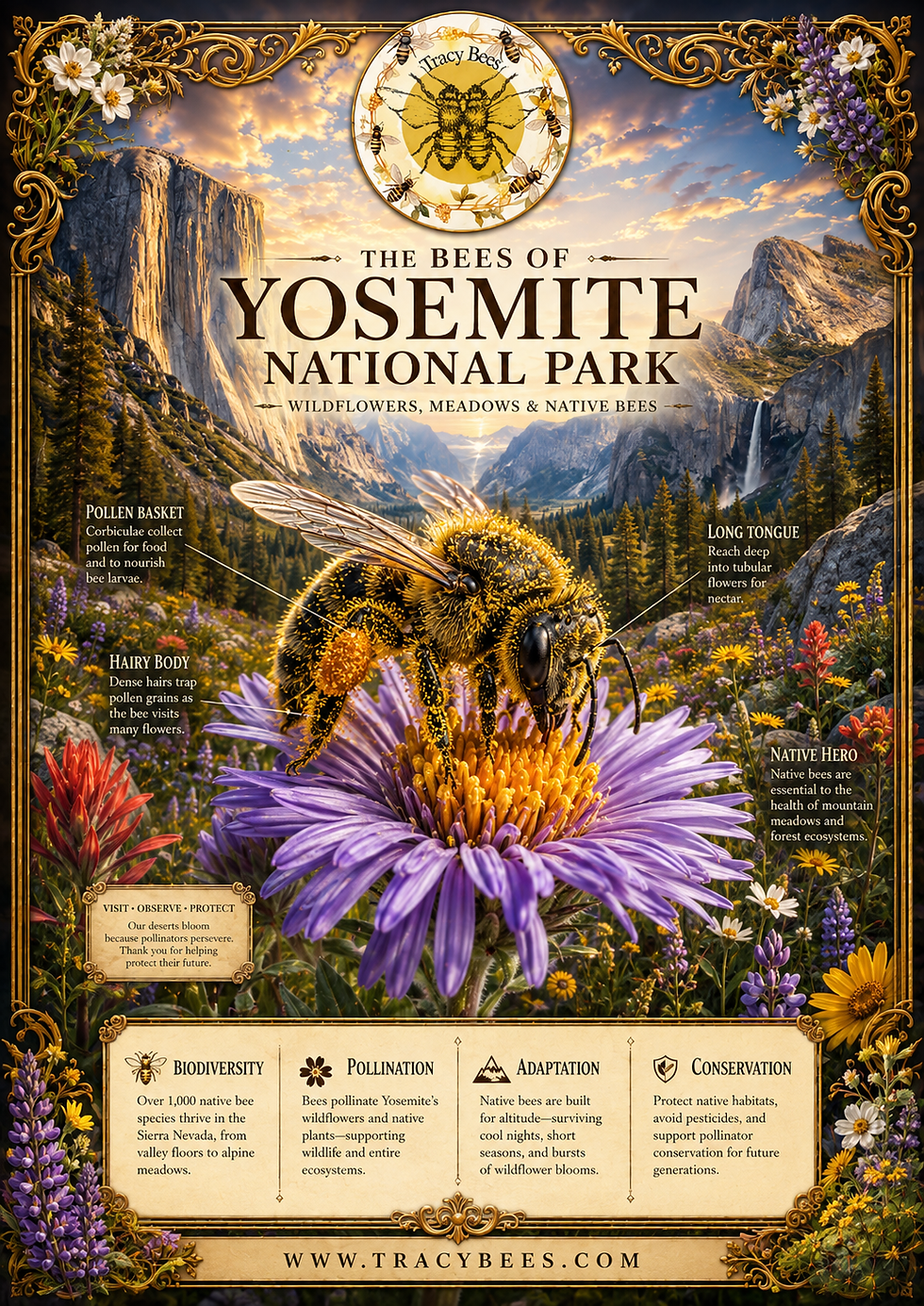
Yosemite National Park is celebrated for granite cliffs, waterfalls, giant sequoias, mountain forests, and broad valleys, but some of its most important ecological activity happens much closer to the ground.
Across meadows, forest openings, riverbanks, and high-elevation slopes, native bees move from flower to flower carrying pollen and helping Yosemite’s plant communities reproduce.
The park’s pollinator story is shaped by elevation. Lower areas can begin blooming while higher elevations are still cold or snow-covered.
As temperatures rise, flowering gradually moves uphill, creating a seasonal wave of nectar and pollen.
For bees, this means Yosemite is not one single habitat. It is a sequence of habitats changing with altitude, moisture, sunlight, and season.
Meadows Full of Pollinator Life
Yosemite’s meadows are especially important for bees. Depending on elevation and time of year, they may support lupines, asters, paintbrushes, penstemons, buckwheats, lilies, monkeyflowers, and many other native blooms.
To a visitor, these meadows are beautiful. To a bee, they are food.
Nectar provides energy, while pollen supplies important nutrients for developing young.
A meadow with many flower species can provide food over a longer period because different plants bloom at different times.
This variety helps support a wider range of pollinators.
Bumble Bees in the Mountains
Bumble bees are especially well suited to Yosemite’s cooler elevations.
Their large, fuzzy bodies help them retain heat, allowing some species to forage during cool mornings or cloudy weather when smaller bees may be less active.
They are also strong flyers and can work large flowers or deep tubular blossoms.
Some perform buzz pollination, vibrating flowers to release pollen that might otherwise remain trapped.
These abilities make bumble bees important pollinators in mountain environments where the growing season can be short.
Forest Edges and Openings
Dense forest does not always provide abundant flowers, but the edges of forests often do.
Where sunlight reaches the ground, shrubs and wildflowers can flourish.
Meadows, trail edges, natural clearings, burned areas, and river corridors can become concentrated feeding areas for bees.
These habitat transitions are important because they provide variety.
A bee may move from a meadow into a shrub-covered edge and then toward flowering plants near water, all within one foraging trip.
Water Shapes the Bloom
Yosemite’s waterfalls, rivers, streams, and snowmelt are central to the park’s ecology.
Water influences which plants grow and how long they remain in bloom.
Wet meadows and riverbanks may stay green and productive after drier slopes begin to fade.
For pollinators, these moist areas can extend the feeding season.
Water does more than create Yosemite’s famous scenery.
It helps determine where flowers appear and how long they remain available.
Hidden Nests Beneath the Ground
Many native bees are solitary and nest underground.
A female may excavate a small tunnel, create brood chambers, fill each one with pollen and nectar, lay an egg, and seal it. The developing bee may remain beneath the soil for months.
Other species use cavities in wood or hollow stems.
Mason bees may use mud to divide brood chambers, while leafcutter bees use pieces of leaves.
These nesting behaviors show why healthy pollinator habitat requires more than flowers. Bees need places to feed and places to reproduce.
Pollen and Plant Reproduction
When a bee enters a flower, pollen sticks to the hairs on its body.
Some is intentionally collected and carried back to the nest.
Some remains behind and is transferred to the next flower.
That transfer may lead to fertilization and seed production.
The effect spreads outward.
Seeds become new plants.
Plants provide food and shelter.
Wildlife benefits.
Roots help stabilize soil.
Pollination supports far more than the flower itself.
Fire and New Flowering Habitat
Wildfire is part of Yosemite’s natural ecology.
Although fire can remove vegetation, it can also create new flowering habitat during recovery. When sunlight reaches previously shaded ground, wildflowers and shrubs may respond quickly.
For bees, those newly opened areas can become rich feeding grounds.
As vegetation grows back, the habitat changes again.
Pollinator communities change with it.
This is another reminder that natural landscapes are dynamic rather than fixed.
Alpine Pollinators and Short Summers
At Yosemite’s highest elevations, bees face colder temperatures, strong winds, and a very short growing season.
Once snow melts, plants must bloom quickly.
Pollinators must respond just as quickly.
In some alpine environments, the entire adult season of a bee may overlap with only a few weeks of flowering.
The timing is remarkable.
Snow melts.
Flowers appear.
Bees emerge.
Pollination happens.
Seeds develop.
Then winter returns.
Why Diversity Matters
Different bees perform different jobs.
Some have long tongues.
Some have short tongues.
Some tolerate cold.
Others prefer warmer conditions.
Some nest in soil.
Others use cavities.
Some visit many kinds of flowers.
Others are more specialized.
This diversity gives Yosemite’s plant communities multiple ways to receive pollination.
A diverse pollinator community creates resilience.
Climate and Changing Seasons
Pollination depends on timing.
If warmer conditions cause flowers to bloom earlier, bees must also emerge early enough to use them.
Drought can reduce blooms.
Changes in snowpack can alter meadow moisture.
Extreme heat can shorten foraging windows.
Mountain parks are especially useful for studying these shifts because conditions change so dramatically with elevation.
Yosemite provides an important natural setting for understanding how pollinators and plants respond to changing seasons.
Giant Landscapes, Small Relationships
Yosemite is famous for monumental features.
El Capitan.
Half Dome.
Waterfalls.
Giant sequoias.
Mountain valleys.
But those iconic features exist within ecosystems supported by much smaller relationships.
A bee landing on a flower may seem insignificant beside a granite cliff, yet that visit can help produce another generation of plants.
Those plants may support insects, birds, mammals, and other wildlife.
The grand landscape depends on small processes.
Protecting Yosemite’s Pollinators
Visitors can help by staying on designated trails, leaving wildflowers in place, respecting meadow restoration areas, and avoiding disturbance to bare soil or visible bee nests.
At home, planting native flowers, reducing pesticide use, and leaving some natural nesting habitat can support local pollinators.
The same principles that protect bees in national parks can be applied almost anywhere.
Wildflowers Beneath the Granite
Yosemite teaches us to look at nature on two scales at once.
Look up at the cliffs.
Then look down at the meadow.
The granite tells one story.
The flower tells another.
And the bee connects us to the living processes happening between them.
Across Yosemite’s meadows, riverbanks, forest openings, and high country, native bees continue their work gathering food, carrying pollen, and helping another generation of wildflowers begin.
The Bees of Great Smoky Mountains National Park
Pollinators of Misty Forest Wildflowers

The Bees of The Smoky Mountains
Pollinators of Misty Forest Wildflowers
Great Smoky Mountains National Park is a landscape of mist, mountain streams, rich forests, flowering shrubs, and extraordinary biodiversity.
Across its valleys, forest edges, meadows, and higher elevations, native bees move quietly through one of the most biologically diverse regions in North America.
The Smokies are especially interesting because elevation creates different climates within the same park.
Lower slopes warm earlier in the year, while higher elevations remain cooler for longer.
This means flowers do not all bloom at once. Instead, spring and summer move gradually up the mountains, creating a shifting season of nectar and pollen.
For bees, elevation becomes a calendar.
Spring Wildflowers and Early Pollinators
Before the forest canopy fully leaves out in spring, sunlight reaches the forest floor and woodland wildflowers take advantage of the brief opportunity.
Trilliums, violets, phacelias, spring beauty, and many other native plants can bloom during this early period.
These flowers are especially important for bees emerging after winter.
Nectar provides energy.
Pollen provides nutrients needed for developing young.
A bee that emerges early in the season depends on flowers being available at exactly the right time.
That connection between bloom timing and bee activity is one of the most important relationships in temperate forests.
Rhododendrons, Mountain Laurel, and Summer Blooms
As the season progresses, flowering shrubs become more important.
Rhododendrons and mountain laurels are among the most recognizable plants of the Smokies, and their blossoms can attract a variety of pollinators.
Bees may also visit blackberries, blueberries, asters, goldenrods, bee balms, and many other flowering plants found along sunny edges, roadsides, openings, and mountain meadows.
Different flowers attract different bees.
Large bumble bees can work sturdy blossoms.
Long-tongued species can reach nectar hidden inside deeper flowers.
Tiny solitary bees may specialize on smaller blooms.
Together, they create a diverse pollination community.
Bumble Bees in Cool Mountain Air
Bumble bees are particularly well suited to the Smokies.
Their large, fuzzy bodies help them retain heat, allowing them to forage during cool mornings and cloudy conditions when smaller bees may be less active.
Mountain weather can change quickly.
Fog settles in.
Rain arrives.
Temperatures fall.
Then the sun returns.
A bee that can continue working through cool conditions gains an important advantage.
Bumble bees are also strong flyers, and some are capable of buzz pollination, vibrating flowers to release pollen.
These abilities make them valuable pollinators in mountain forests and meadows.
Forest Edges Are Pollinator Hotspots
Dense forest does not always provide abundant flowers, but forest edges often do.
Where sunlight reaches the ground, shrubs and wildflowers can flourish.
Natural clearings.
Trail edges.
Streambanks.
Meadows.
Openings created by fallen trees.
These areas can become concentrated feeding grounds for bees.
A single sunny patch within a forest may support far more pollinator activity than the shaded woodland surrounding it.
This is why habitat variety is so important.
Healthy forests need both dense cover and open flowering spaces.
Streams and Moist Mountain Habitat
The Great Smoky Mountains contain an enormous network of streams.
These waterways influence which plants grow and how long flowers remain available.
Moist streambanks may support lush vegetation even when nearby slopes become drier.
For bees, these areas can function like corridors through the forest.
Flowers follow moisture.
Pollinators follow flowers.
Water therefore helps organize the movement of life across the mountains.
The Hidden Nests of Native Bees
Most native bees do not live in large colonies.
Many are solitary.
A female ground-nesting bee may excavate a tunnel, create brood chambers, gather pollen and nectar, lay an egg, and seal the chamber.
Other bees use cavities in wood or hollow stems.
Mason bees may divide chambers with mud.
Leafcutter bees use pieces of leaves.
Carpenter bees excavate tunnels in wood.
These differences show why pollinator habitat requires more than flowers.
Bees also need soil, stems, dead wood, and other natural nesting materials.
Pollen Connects the Forest
When a bee enters a flower, pollen sticks to the hairs covering its body.
Some is intentionally collected for the nest.
Some remains behind and is transferred to another flower.
That transfer may lead to fertilization and seed production.
The effects spread outward.
Seeds become new plants.
Plants provide food.
Berries feed birds and mammals.
Roots stabilize slopes.
Vegetation creates shelter.
A bee visiting one flower becomes part of a much larger forest food web.
Biodiversity Creates Resilience
The Smokies are famous for biological diversity, and that diversity helps the ecosystem remain resilient.
Different bee species can work under different conditions.
Some tolerate cooler temperatures.
Some visit many plant species.
Others are more specialized.
Some nest underground.
Others use cavities.
This variety creates multiple ways for pollination to continue.
If one species struggles, another may still perform an important ecological role.
Biodiversity gives the forest options.
Climate and Changing Bloom Times
Pollination depends on timing.
If warmer spring temperatures cause flowers to bloom earlier, bees must also emerge early enough to use them.
Changes in rainfall can reduce or extend flowering periods.
Extreme heat can shorten foraging time.
Heavy storms can damage blooms.
Mountain ecosystems are especially sensitive because temperature changes with elevation.
The Smokies provide scientists with an important place to study how plants and pollinators respond to changing seasons.
Protecting Pollinators in the Smokies
Visitors can help through simple choices.
Leave wildflowers where they grow.
Stay on designated trails.
Avoid disturbing exposed soil and dead wood.
Do not interfere with bee nests.
Respect restoration areas.
Observe pollinators without handling them.
At home, planting native flowers, reducing pesticide use, and preserving natural nesting materials can create valuable habitat for local bees.
Looking Into a Smoky Mountain Flower
The Great Smoky Mountains are famous for their sweeping views.
Blue ridges.
Mist.
Forest.
Streams.
But the ecological story becomes even more interesting when we look closer.
A bee enters a flower.
Pollen collects on its body.
It moves to another bloom.
A seed begins.
Another plant becomes possible.
The bees of Great Smoky Mountains National Park remind us that some of the most important work in the forest happens quietly, close to the ground.
Among misty ridges, woodland flowers, mountain streams, and flowering shrubs, native bees continue their ancient work carrying pollen and helping the forest renew itself one bloom at a time.
The Bees of Everglades National Park

The Bees Of The Everglades
Pollinators of the River of Grass
Everglades National Park presents a completely different pollinator world from the mountain and forest landscapes we have explored so far.
Here, water becomes the force that organizes almost everything.
Sawgrass marshes stretch across the horizon, mangroves line coastal areas, cypress trees rise from wetlands, and seasonal changes in rainfall determine where plants grow, when flowers appear, and which habitats remain dry enough for insects to nest.
Within this warm subtropical landscape, native bees and other pollinators move among flowering plants adapted to heat, humidity, flooding, and long growing seasons.
The Everglades remind us that pollination is not limited to meadows and mountain forests.
It is just as important in wetlands, where plant communities help stabilize soil, support wildlife, and maintain the ecological structure of one of America’s most distinctive protected landscapes.
A Landscape Shaped by Water
The Everglades are often called the “River of Grass” because water once moved slowly across an enormous shallow landscape.
That water shapes nearly every ecological relationship.
Some areas remain wet for long periods.
Others dry seasonally.
Slight changes in elevation can determine which plants survive.
For bees, these differences matter because nesting opportunities and flowering plants may be concentrated on relatively dry ground, tree islands, upland edges, and other suitable areas.
Pollinators must navigate a landscape that changes with water.
Flowers in a Wetland World
The Everglades contain far more flowering diversity than the wide expanses of sawgrass might suggest.
Wildflowers, shrubs, trees, mangroves, and other flowering plants provide nectar and pollen throughout different parts of the year.
Warm temperatures can allow a longer flowering season than in mountain parks such as Yellowstone or Yosemite.
This means some pollinators may have access to food for much longer periods.
But the challenge is different.
Humidity is high.
Rain can be intense.
Flooding changes habitat.
Storms can reshape vegetation.
Pollinators must adapt to those conditions.
Native Bees in South Florida
Native bees in South Florida include many solitary species.
Some nest in soil.
Others use cavities in wood or hollow plant material.
Small sweat bees, carpenter bees, leafcutter bees, and other native groups may visit flowers throughout subtropical environments.
Because these species do not all live in large colonies, their nesting habitat can be easy to overlook.
A bee may spend part of its life underground or inside a small cavity and only become visible when it begins foraging.
The flowers tell us where the bees are.
Mangroves and Coastal Pollination
Mangrove ecosystems are among the most important coastal habitats in South Florida.
Their roots stabilize shorelines and provide nursery habitat for many aquatic species.
Mangrove flowers can also attract insects.
Pollinators visiting coastal plants help support reproduction in environments influenced by salt, tides, heat, and storms.
These conditions differ dramatically from mountain meadows.
Yet the same basic process continues.
A pollinator visits.
Pollen moves.
Seeds develop.
Another generation begins.
Heat, Humidity, and Daily Activity
In subtropical environments, bees face a very different temperature challenge from those in the high country.
Instead of struggling primarily with cold, they may need to avoid excessive heat.
Morning can become an important foraging period.
Flowers may contain fresh nectar.
Temperatures are more comfortable.
As midday heat increases, activity may change.
Different species respond differently.
Some tolerate high temperatures better than others.
Again, diversity creates flexibility.
Pollen Still Connects Everything
No matter how different the landscape becomes, the basic relationship between bees and flowers remains remarkably familiar.
A bee enters a blossom.
Pollen catches in its body hairs.
Some is collected as food.
Some remains on the bee.
When the bee visits another flower, pollen may be transferred.
That transfer can lead to seed production.
In a wetland ecosystem, those seeds help maintain plant communities that provide food, shelter, nesting habitat, and protection for other species.
The bee is part of a much larger system.
Wetlands Depend on Plant Diversity
Healthy wetlands contain many kinds of plants.
Some tolerate standing water.
Others grow along edges.
Some occupy slightly elevated ground.
Mangroves dominate certain coastal areas.
Cypress communities create another type of habitat.
Flowering plants woven through these environments provide important resources for insects.
Plant diversity supports pollinator diversity.
Pollinator diversity, in turn, helps support plant reproduction.
The relationship moves in both directions.
Nesting in a Wet Landscape
Wetlands create an unusual challenge for ground-nesting bees.
Flooded soil is not suitable for every species.
This makes dry patches especially valuable.
Slightly elevated areas.
Upland edges.
Sandy soil.
Tree islands.
Disturbed but dry openings.
These locations may provide nesting opportunities when surrounding areas are too wet.
Other species avoid the problem by nesting in cavities.
Wood, stems, and natural holes can provide protected spaces above saturated ground.
Hurricanes and Habitat Change
South Florida is shaped by storms.
Hurricanes can damage vegetation, flood habitat, open forest canopies, and alter coastal areas.
For pollinators, this can create both challenges and opportunities.
Flowers may be lost temporarily.
Nesting material may disappear.
But storm-created openings can also increase sunlight and encourage new flowering growth.
As vegetation recovers, pollinator communities respond.
This is another example of nature continually rebuilding itself.
Climate and Water Patterns
The Everglades depend on the timing and movement of water.
Changes in rainfall, drought, sea level, water management, and temperature can influence plant communities.
If flowering plants shift, pollinators must shift with them.
If dry nesting areas become wetter, certain bees may lose habitat.
If coastal conditions change, mangrove communities may move.
These relationships make pollinators part of the larger story of Everglades conservation.
Pollination Supports Wildlife
Wetlands are famous for birds, reptiles, fish, mammals, and aquatic life.
Pollination may seem far removed from those animals.
It is not.
Flowering plants produce seeds and fruits.
Plants create nesting cover.
Vegetation stabilizes shorelines.
Roots create habitat.
Insects themselves become food for birds and other animals.
The influence of pollination spreads through the ecosystem.
A bee visiting a small flower may be contributing indirectly to a habitat used by wildlife much larger than itself.
The Importance of Native Plants
Native plants are especially important in the Everglades because they are adapted to local water, temperature, soil, and seasonal conditions.
Native pollinators often have long ecological relationships with these plants.
When native vegetation is replaced by invasive species, those relationships can change.
Some introduced plants provide nectar.
Others do not support the same diversity of insects.
Protecting native plant communities therefore helps preserve the broader pollinator network.
Why Wetland Pollinators Matter
Pollinators in wetland environments are easy to overlook because attention often goes to wading birds, alligators, mangroves, and vast sawgrass landscapes.
But flowers still need visitors.
Seeds still need to form.
Plant communities still need to renew themselves.
Bees are part of that renewal.
They help connect one flowering season to the next.
Protecting Everglades Pollinators
Visitors can help by staying on designated paths and boardwalks, leaving flowers and vegetation undisturbed, and observing insects without attempting to capture them.
Protecting wetlands also means protecting the water systems that sustain them.
Outside the park, native plant gardens and reduced pesticide use can support South Florida pollinators.
Even small patches of appropriate flowers can provide valuable food.
The River of Grass in Bloom
The Everglades may appear quiet from a distance.
Sawgrass stretches toward the horizon.
Water reflects the sky.
A heron stands motionless.
Mangroves create dense green walls.
Then you look closer.
A flower opens near the edge of the water.
A bee arrives.
It gathers pollen.
It moves to another bloom.
The enormous wetland suddenly becomes connected to one tiny interaction.
That is the beauty of pollination.
The process remains simple even when the landscape changes completely.
From Yellowstone’s cold high country to Yosemite’s mountain meadows, from the misty forests of the Smokies to the warm wetlands of South Florida, bees continue the same ancient work.
In Everglades National Park, they do it surrounded by water.
One flower.
One flight.
One wetland generation at a time.
The Journey Continues
From Mountains and Forests to the Next Wild Landscape
From Yellowstone’s high-country meadows to Yosemite’s granite valleys, from the mist-covered forests of the Great Smoky Mountains to the wetlands of the Everglades, Part Two of the Tracy Bees National Parks Pollinator Series has shown just how adaptable and important native bees can be.
Each park gives pollinators a different challenge.
Cold mountain mornings.
Short alpine summers.
Dense forest shade.
Changing elevations.
Rivers and streams.
Heat, humidity, and wetlands.
And yet, across all of these landscapes, the same ancient relationship continues.
Flowers open.
Bees arrive.
Pollen moves.
Plants reproduce.
Seeds begin another generation.
That simple process connects bees to forests, meadows, wetlands, wildlife, soil, water, and the larger ecosystems around them.
This is why pollinator conservation matters.
Protecting bees does not mean protecting insects alone. It means protecting the flowers they visit, the soil they nest in, the stems and wood they use for shelter, and the landscapes that allow them to survive.
Explore Part One
If you have not yet read the first installment, continue the journey with:
The Bees of America’s National Parks
Part One explores pollinators across desert and canyon landscapes, including Saguaro National Park, Grand Canyon National Park, Petrified Forest National Park, and Joshua Tree National Park.
Together, Parts One and Two begin to show the extraordinary range of habitats in which bees live and work across America’s protected landscapes.

Continue the Journey: Part Three
From mountains, forests, and wetlands, the Tracy Bees National Parks Pollinator Series now moves into canyons, hoodoos, and volcanic landscapes.
Part Three explores Zion National Park, Bryce Canyon National Park, Haleakalā National Park, and Hawaiʻi Volcanoes National Park, revealing how bees and other pollinators survive across red-rock deserts, cool high-country environments, volcanic alpine habitats, and unique Hawaiian ecosystems.
Continue to Part Three below

More From Tracy Bees

Visit www.tracybees.com to explore more about bees, pollinators, nature, conservation, and the remarkable relationships that keep the natural world blooming.
You can also explore the Tracy Bees Library for more educational features, books, and nature-centered resources.
And, of course, the bees and pollinators moving quietly through them.
The journey continues.
One park.
One flower.
One pollinator at a time.


Comments