


How Bees See the world: ultraviolet vision, color & flower guides
- Tracy Bees
- 14 hours ago
- 26 min read

How Bees See Color
How Bees See the World
Understanding how bees see the world reveals a remarkable landscape of ultraviolet light, color, floral patterns and hidden signals that humans cannot naturally see.

A flower-filled garden may look spectacular to the human eye, but a honey bee moving through that same landscape experiences a remarkably different visual world.
Humans and honey bees are both trichromatic, meaning that each relies on three primary types of color-sensitive photoreceptors, yet those receptors are tuned to different portions of the light spectrum. Human color vision is based broadly on receptors sensitive to short, medium, and long wavelengths that allow us to perceive the familiar range we describe as blue, green, yellow, orange, and red. Honey bees, by contrast, are particularly sensitive to ultraviolet, blue, and green wavelengths.
Their ability to detect ultraviolet light wavelengths beyond what our unaided eyes can see opens an entire dimension of floral information that remains hidden from human vision.
This difference is especially important because flowers are not simply beautiful objects scattered across the landscape. They are reproductive structures, and many have developed visual characteristics that help attract the animals responsible for moving pollen from flower to flower. Some blossoms possess ultraviolet-reflective and ultraviolet-absorbing regions that create distinctive patterns invisible to us.
These markings may form rings, contrasting centers, radiating lines, spots, or other configurations commonly described as nectar guides. To a foraging bee, these contrasts can help identify and orient toward the portion of a flower containing nectar, pollen, and reproductive structures.
A blossom that appears almost uniformly yellow, pink, white, or purple to us may therefore look dramatically patterned to a bee. Its center may contrast sharply with its petals, or ultraviolet markings may create a visual pathway leading inward.
Flowers can also combine color with shape, symmetry, scent, texture, brightness, and spatial arrangement, producing a multisensory signal that helps pollinators recognize potentially rewarding plants. Bees are capable learners as well. After discovering flowers that provide profitable sources of nectar or pollen, they can learn associated colors, odors, shapes, and locations and use that information during later foraging trips.
Bee vision is also built for movement. A honey bee's two large compound eyes are composed of thousands of individual optical units called ommatidia.
Rather than functioning exactly like a human camera-like eye, these many visual units collectively provide information about the bee's surroundings and are especially useful for detecting motion, navigating through vegetation, approaching flowers, and controlling flight.
Bees also possess three smaller simple eyes called ocelli, located on the top of the head. These structures primarily sense changes in light intensity and contribute to orientation rather than producing detailed images.
The result is a visual system beautifully suited to the life of a flying pollinator. Bees do not need to see the world exactly as humans do. They need to recognize flowers while moving quickly, distinguish useful patterns, navigate changing landscapes, respond to light, and efficiently locate food. Their ultraviolet sensitivity and specialized eyes allow them to gather visual information that humans simply cannot perceive without specialized imaging equipment.
This also means that the colors we experience are not the only colors that matter in nature. Every animal's visual world is shaped by its biology. What appears to us as an ordinary wildflower meadow may contain an extraordinary network of signals when viewed through the sensory abilities of a bee hidden contrasts, ultraviolet markings, floral targets, and pathways that have helped connect flowering plants with their pollinators across evolutionary time.
Throughout this Tracy Bees exploration, we will look more closely at the extraordinary structures inside a bee's eyes, compare human and bee color vision, explore ultraviolet light, examine floral nectar guides, discover why certain flower colors are especially noticeable to bees, answer the fascinating question of whether bees can see red, and learn how this knowledge can help us create gardens that better support pollinators.
The deeper we look into bee vision, the clearer one thing becomes: the garden we see is only part of the garden that is truly there.
Inside a Bee's Eyes: Compound Eyes and Ocelli

To understand how bees experience the world, we first have to look closely at the remarkable structures that make their vision possible. A honey bee has five eyes in total: two large compound eyes positioned on the sides of the head and three much smaller simple eyes, called ocelli, arranged near the top of the head. These different visual systems do not perform identical jobs. Instead, they work together, giving the bee a powerful combination of motion detection, color perception, light sensing, orientation, and spatial awareness that is perfectly suited to life in flight.
The two large compound eyes are the most visually striking. Each is made up of thousands of tiny visual units called ommatidia. Every ommatidium receives light from a slightly different direction, and the bee's nervous system combines these many small pieces of visual information into a broad representation of the surrounding environment. This is very different from the way a human eye forms a single detailed image through a lens. A bee's compound eyes are especially effective at detecting movement and changes across a wide field of view, which is critically important for an animal that must fly rapidly through flowers, branches, shadows, and shifting light.
These compound eyes are also where much of the bee's color vision occurs. Honey bees have photoreceptors sensitive primarily to ultraviolet, blue, and green wavelengths. This gives them access to visual information that humans cannot naturally perceive, including ultraviolet markings on flowers. While humans often admire a flower for its visible color alone, a bee may detect additional patterns that dramatically change the appearance of the blossom. The compound eyes help bees recognize these visual signals, evaluate contrast, identify flower shapes, and respond to patterns associated with nectar and pollen.
Movement detection is another extraordinary strength of compound vision. Flying requires constant visual adjustments. A bee must determine how quickly objects are passing, how close a flower is, where obstacles are located, and how to position its body for landing. The many ommatidia provide rapid visual sampling across a broad area, helping the bee react quickly as it moves through the environment. This sensitivity to motion also contributes to navigation and allows bees to maintain stable flight even in visually complex surroundings.
Above the compound eyes are the three ocelli, or simple eyes. These are much smaller and structurally simpler than the compound eyes. They are not responsible for producing detailed images of flowers or landscapes. Instead, they are particularly sensitive to overall light intensity and changes in illumination. The ocelli help the bee monitor brightness in the sky and surrounding environment, contributing to orientation and flight stability. They are especially useful when lighting changes quickly for example, when a bee moves between sunlight and shade or flies beneath vegetation.
Together, the compound eyes and ocelli create a beautifully coordinated visual system. The compound eyes provide information about color, patterns, movement, and the surrounding landscape, while the ocelli help track changing light conditions and support orientation. Neither system works in isolation. Their combined information helps a bee approach flowers, maintain flight, avoid obstacles, navigate away from the hive, and successfully return home.
The structure of a bee's eyes also reminds us that vision does not have to resemble human vision to be extraordinarily effective.
Bees are not attempting to see fine detail in exactly the way we do. Their visual system has been shaped by the demands of their own lives: flying at speed, locating small flowers across large areas, responding quickly to movement, recognizing rewarding floral signals, and navigating through changing environments.
When we look closely at a bee's face, those enormous compound eyes and three tiny ocelli reveal far more than an unusual anatomy. They represent a highly specialized sensory system designed for one of nature's most important partnerships the relationship between pollinators and flowering plants. Every flight from blossom to blossom depends on these remarkable eyes gathering information from a world filled with light, movement, color, and patterns that are often completely invisible to us.
What Bees Can See
A World of Blue, Green & Ultraviolet

Once we understand the structure of a bee’s eyes, the next question becomes even more fascinating:
what does the world actually look like to a bee?
Honey bees do not see color in the same way humans do. Our visual system is built around three main types of color receptors that are most sensitive to wavelengths we interpret broadly as red, green, and blue. Honey bees are also trichromatic, but their three primary receptor types are tuned differently. They are especially sensitive to ultraviolet, blue, and green light, which means the colors and patterns that stand out to them can be very different from the ones that catch our attention.
This difference creates a visual world that overlaps with ours, but is not identical to it. Bees can see many blues, greens, yellows, and violet-like colors very effectively, but they do not possess a receptor specifically tuned to the long wavelengths that humans experience as red. Because of this, many pure red surfaces appear much darker or less distinct to bees than they do to us. Yet bees are not simply moving through a dull or limited landscape. Their ability to detect ultraviolet light gives them access to information that humans cannot see naturally, revealing hidden floral markings and contrasts that can make a flower dramatically more noticeable.
Ultraviolet vision is particularly important in the relationship between bees and flowers. Many blossoms contain areas that reflect or absorb ultraviolet wavelengths differently across their petals. These differences can create rings, dark centers, glowing-looking edges, radiating lines, or target-like patterns from the bee’s perspective. Such markings often help guide a bee toward the flower’s reproductive center, where nectar and pollen may be available. What appears to us as a uniformly colored blossom can therefore function as a highly patterned visual signal to a bee.
Color is only one part of the picture. Bees are excellent at recognizing contrast, shape, symmetry, pattern, and movement. A flower that does not strongly match a bee’s preferred color range may still be easy to locate if it has a distinctive outline, a contrasting center, or ultraviolet markings. Bees also learn. After repeatedly visiting rewarding flowers, they can associate certain colors, shapes, scents, and locations with food. This learning ability helps make their foraging more efficient and allows them to return to productive plants again and again.
The difference between human and bee vision also illustrates an important truth about nature: the world does not have only one visual appearance. Every species experiences light through the limits and strengths of its own sensory system. Humans see one version of a meadow. Bees see another. Birds, butterflies, and other animals may experience still different versions. The colors we call “beautiful” are only part of a much larger visual environment filled with wavelengths, contrasts, and patterns that our eyes simply cannot detect.
For honey bees, this specialized vision is closely tied to survival. Their ability to distinguish useful floral signals helps them find nectar and pollen efficiently, while their sensitivity to movement and contrast helps them navigate through vegetation and changing landscapes. A productive flower must stand out among leaves, shadows, stems, and competing blossoms, and bee vision is well adapted to recognizing those differences quickly.
This is why blue, violet, green, and ultraviolet play such an important role in the sensory world of bees. These wavelengths help create a visual map of the landscape one that guides bees from flower to flower and connects them with the resources they need. What we experience as a colorful garden is, for a bee, an even more complex world of visible and invisible signals working together.
The more we learn about this visual world, the easier it becomes to understand why certain flowers are especially attractive to bees and why ultraviolet patterns are so important. The next step is to look more closely at one of the most extraordinary parts of bee vision: the hidden ultraviolet light that bees can detect but humans cannot see.
Ultraviolet Light
The Hidden World Bees Can Detect

Ultraviolet light is one of the most extraordinary parts of bee vision because it allows bees to perceive a layer of the natural world that remains completely invisible to the unaided human eye. Ultraviolet, or UV, light lies just beyond the violet end of the visible spectrum.
Humans generally perceive wavelengths from roughly 400 to 700 nanometers, while honey bees can detect shorter wavelengths extending into the ultraviolet range, roughly around 300 to 400 nanometers, in addition to blue and green light. This difference means that a flower that appears ordinary or uniformly colored to us may reveal striking patterns, glowing contrasts, or dark central markings when viewed through a bee’s visual system.
Many flowering plants reflect and absorb ultraviolet light in highly specific ways. Some petals contain regions that strongly reflect UV light while other areas absorb it, creating patterns that may look like rings, lines, spots, or dramatic dark centers. These patterns are often associated with the flower’s reproductive structures and can help guide bees toward nectar and pollen. To us, these markings may be completely hidden, but to a bee they can function like visual signposts directing attention toward the most rewarding part of the blossom.
This is one reason ultraviolet vision is so important to pollination.
A bee flying quickly through a field must make rapid decisions about which flowers to approach and where to land. UV-sensitive vision helps flowers stand out against leaves, stems, soil, and surrounding vegetation. Once the bee reaches the flower, ultraviolet contrast can help orient its body toward the center, improving the efficiency of nectar collection and increasing the likelihood that pollen will be transferred between blossoms.
Ultraviolet patterns are sometimes described as nectar guides, although the term can include visible patterns as well. These guides may radiate inward from the edges of petals, form dark bull’s-eye shapes around the flower center, or appear as contrasting veins and spots. The precise pattern differs from species to species, giving flowers distinctive visual identities. Bees can learn these patterns and associate them with rewarding food sources, allowing experienced foragers to recognize profitable flowers more quickly.
The presence of ultraviolet markings also demonstrates how deeply interconnected flowers and pollinators are. Flower color did not develop merely for human appreciation. Floral appearance is part of a much larger biological communication system shaped by interactions between plants and the animals that visit them. For a bee, a flower may be communicating through multiple channels at once: visible color, ultraviolet contrast, scent, shape, texture, and nectar reward.
Together, these signals help the bee decide where to land and whether a particular blossom is worth revisiting.
Ultraviolet vision does not mean that bees see every flower as glowing purple or blue.
Their experience is far more complex than simply adding an extra color to the human spectrum. Bee brains combine signals from ultraviolet-, blue-, and green-sensitive receptors to create their own perception of color and contrast.
Scientists can approximate some aspects of bee vision using specialized photography and spectral measurements, but the exact subjective experience of color inside a bee’s nervous system remains something humans cannot directly experience.
What we can observe, however, is the extraordinary effectiveness of this visual system. Bees use ultraviolet information to locate flowers, recognize patterns, orient during foraging, and move efficiently through complex landscapes.
A blossom that seems plain to us may contain an entire visual map designed around wavelengths we cannot see.
Ultraviolet light therefore reveals one of the most beautiful truths about pollination: nature contains information beyond the limits of human perception.
Every garden, meadow, and flowering landscape holds patterns that remain hidden until we consider the world through the sensory abilities of another species.
For bees, ultraviolet light is not mysterious or invisible at all. It is simply part of the everyday visual language of flowers.
And once those hidden markings are revealed, the next question becomes even more fascinating: how do flowers use these patterns to guide bees directly toward nectar and pollen?
Nectar Guides Floral Pathways That Lead Bees to Rewards
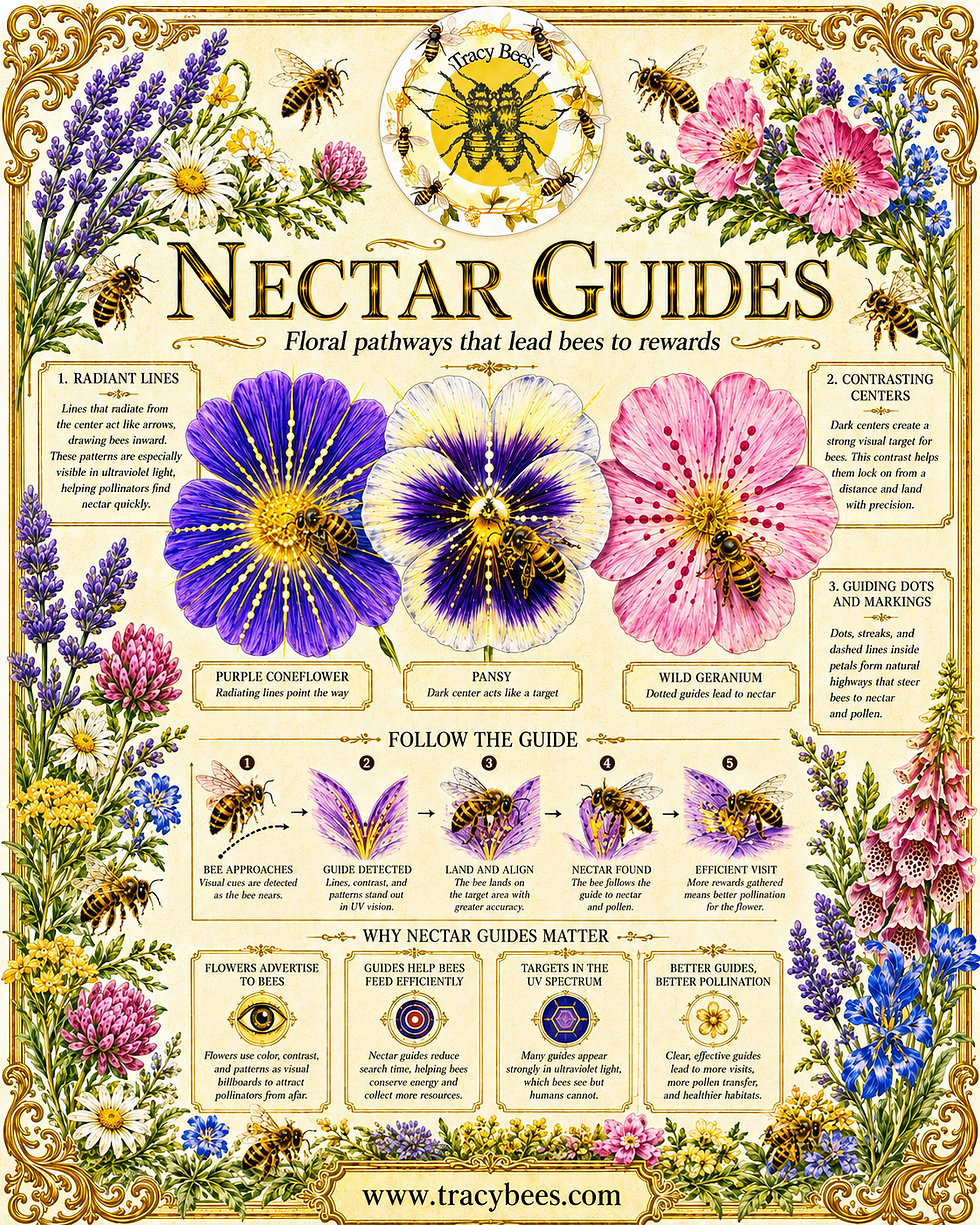
Flowers are far more than colorful decorations in a landscape. Many of them function as highly sophisticated visual signals, using color, contrast, shape, scent, and ultraviolet markings to attract pollinators and direct them toward the parts of the blossom that offer nectar and pollen. Among the most fascinating of these visual features are nectar guides patterns on petals that help bees orient themselves as they approach and land on a flower.
Nectar guides can appear in many forms. Some flowers display radiating lines that seem to point inward toward the center. Others have contrasting central zones, dark rings, dots, spots, veins, or bull’s-eye-like markings. In some species, these patterns are clearly visible to humans. In others, the most important parts of the pattern are visible primarily in ultraviolet light, which means bees may see a visual pathway that is completely hidden from us.
For a foraging bee, this matters enormously. A bee must make thousands of rapid decisions while moving through a flower-filled environment. It must locate rewarding blossoms, approach them safely, land in the correct position, and find nectar or pollen without wasting unnecessary energy.
Nectar guides can help reduce that search time by acting like visual road signs, directing the bee toward the flower’s reproductive center and food rewards.
The process begins before the bee even lands. From a short distance, color and contrast help the flower stand out from leaves, stems, soil, and surrounding blooms.
As the bee moves closer, finer patterns become more important. Radiating lines may converge toward the center. Contrasting patches may form a target. Dots and veins may create a pathway inward. The flower is, in effect, presenting a layered visual message: first attracting the bee from a distance, then guiding it more precisely once it arrives.
Ultraviolet vision makes these signals even more powerful. Many petals reflect ultraviolet light unevenly, creating differences between the outer portion of the flower and the center. To human eyes, a flower may appear uniformly yellow, pink, white, or purple. To a bee, the same blossom may contain a dramatic central target surrounded by contrasting petals.
These UV patterns can make the location of nectar or pollen easier to identify.
Nectar guides also support pollination itself. When a bee is directed toward the reproductive structures of a flower, its body is more likely to contact pollen-producing anthers and pollen-receiving stigmas. Pollen can then adhere to the bee’s body and be carried to another flower of the same species. In this way, a visual pattern that helps a bee find food can simultaneously help the plant reproduce.
The relationship is beautifully efficient. The flower benefits by increasing the likelihood that a pollinator will contact its reproductive structures, while the bee benefits by locating nectar and pollen more quickly. Over evolutionary time, this interaction has contributed to an extraordinary diversity of floral shapes, colors, patterns, and signals.
Bees are also capable of learning these patterns. After visiting rewarding flowers, they can remember combinations of color, shape, scent, and visual structure. A bee that discovers a profitable floral type may become more efficient at recognizing and handling similar flowers during later visits. This learning can reduce search time and make foraging more productive.
Not every flower uses nectar guides in exactly the same way, and not every guide is ultraviolet. Some are visible in the same wavelengths humans can see, while others involve UV contrast, texture, scent, or combinations of multiple signals.
What matters is that flowers communicate with pollinators through a rich sensory language, and bees are exceptionally well equipped to interpret it.
When we look closely at nectar guides, we begin to see flowers differently. The lines, spots, centers, and hidden ultraviolet patterns are not random decoration.
They can be functional signals designed by evolution to connect a pollinator with a reward.
For bees, the message is simple and powerful: follow the pattern, find the flower’s center, and the reward is waiting.
Bee Color Vision Why Blue, Violet, Yellow & White Stand Out

After exploring nectar guides, the next layer of bee vision is color itself.
Honey bees are strongly responsive to certain parts of the spectrum, especially ultraviolet, blue, and green wavelengths, and this influences which flowers are easiest for them to detect and recognize. Flowers that appear blue, violet, yellow, or white to us often create especially strong visual signals for bees because those colors can produce high contrast against green foliage and may also contain ultraviolet-reflective or ultraviolet-absorbing patterns that make the blossoms even more distinctive.
Blue and violet flowers are particularly important in discussions of bee vision because bees are highly sensitive to wavelengths in this portion of the spectrum. To a bee, a blue or violet flower may stand out sharply against the surrounding leaves and stems, making it easier to locate from a distance. This strong contrast can be even more pronounced when the flower also contains ultraviolet markings around its center or along its petals. A blossom that already appears vivid to us may therefore carry an additional layer of visual information that makes it even more noticeable to a foraging bee.
Yellow flowers are also commonly visited by bees, but the way they are perceived can depend on both visible color and ultraviolet properties. Some yellow petals reflect ultraviolet light strongly, while others absorb it in specific regions. This can create a striking bull’s-eye or target-like pattern from the bee’s perspective. A yellow flower that appears relatively uniform to humans may therefore present a much more complex pattern to a bee, with the center visually separated from the outer petals.
White flowers can also be highly visible, especially when they contrast strongly with darker leaves or backgrounds. Many white petals reflect a broad range of wavelengths, and some species display ultraviolet markings that create additional contrast. Their brightness can make them stand out in a landscape, while their centers may provide a separate color or ultraviolet signal that helps the bee orient toward nectar and pollen.
Green occupies a different role. Bees can see green wavelengths very well, but green is also the dominant color of leaves and much of the background vegetation in a garden or meadow. Because of this, a green flower may not always stand out as strongly as a blue, violet, yellow, or white one unless it has additional contrast, pattern, scent, or ultraviolet features. Green sensitivity is still extremely important, however, because it helps bees perceive the structure of the landscape, navigate through vegetation, and distinguish flowers from their surroundings.
Red is a special case. Honey bees do not have a photoreceptor tuned specifically to the long wavelengths humans perceive as red, so many red flowers may appear much darker or less vivid to them. This does not make red flowers invisible. Bees can still locate them through contrast, ultraviolet markings, shape, scent, brightness, and learned associations. Some flowers that appear red to us may also reflect shorter wavelengths that fall within a bee’s visible range, making their appearance more complex than a simple “red versus not red” distinction.
What matters most is that bees do not choose flowers based on human color names alone. Their visual decisions are shaped by the interaction of wavelength, contrast, ultraviolet pattern, flower shape, scent, and reward. A blue flower with a strong ultraviolet center may be highly attractive. A yellow flower with a dark target may be easy to recognize. A white flower with a contrasting center may stand out brilliantly against foliage. A red flower may still be visited if it carries other useful signals.
This is why planting for pollinators is most effective when we think in terms of diversity rather than a single “best” color. Gardens that contain a range of blue, violet, yellow, white, pink, and other blooms, combined with varied shapes and long flowering seasons, provide bees with a richer and more reliable visual and nutritional landscape.
Grouping similar flowers together can also make them easier for bees to spot and revisit.
The remarkable thing about bee color vision is that it reveals how differently two species can experience the same garden.
What looks like a collection of familiar flower colors to us may appear to a bee as a landscape of powerful contrasts, hidden ultraviolet patterns, dark centers, bright targets, and highly recognizable visual signatures.
For bees, color is not simply decoration. It is information a tool that helps them find food, recognize rewarding flowers, and move efficiently through a complex living world.
Flowers That Advertise Best
How Plants Attract Pollinators

Flowers are not passive decorations waiting to be discovered. They use an extraordinary combination of color, contrast, scent, shape, pattern, nectar, pollen, and timing to attract pollinators and encourage repeated visits. From a bee’s perspective, a successful flower is one that can be noticed quickly, recognized easily, approached safely, and remembered as a reliable source of food.
Color is one of the first signals a bee may notice. Blue, violet, yellow, and white blossoms often create strong contrast against green foliage, while ultraviolet markings can add an additional layer of visibility that humans cannot see. But color alone is rarely the whole story. Many flowers combine vivid petals with dark centers, radiating lines, or contrasting patterns that help guide bees toward the reproductive structures and reward inside.
Shape also matters. Open, accessible flowers such as daisies and coneflowers provide broad landing platforms that allow bees to approach easily and move across the flower while collecting nectar and pollen. Tubular or bell-shaped flowers, such as foxglove, present a different challenge and may reward bees that are able to enter and navigate deeper into the blossom. Each flower shape creates a different relationship between pollinator and plant.
Scent adds another important layer. Floral fragrances can travel through the air and help bees locate rewarding flowers even when visual conditions are difficult. Bees are highly sensitive to odors and can learn to associate a particular scent with nectar or pollen. Once a bee discovers a productive flower, that scent can become part of a powerful memory that guides future foraging trips.
Nectar and pollen are the rewards that make the entire system work. Nectar provides carbohydrates that fuel flight and daily activity, while pollen supplies proteins, fats, vitamins, minerals, and other nutrients essential to the colony. Flowers that offer abundant, accessible rewards are often visited repeatedly, especially when their visual and scent signals make them easy to recognize.
The timing of bloom is just as important as the appearance of the flower.
A garden that produces blossoms only during one short period may provide a temporary abundance followed by scarcity.
A garden designed with successive flowering periods from spring through fall offers a much more reliable food source. Early-blooming plants support bees emerging or becoming active at the beginning of the season, while late-blooming flowers help sustain pollinators as other resources decline.
Plant diversity also increases the value of a landscape. Different bee species vary in body size, tongue length, flight range, and floral preferences.
A garden containing a mixture of flower shapes, heights, colors, and bloom times can support a wider range of pollinators than a garden dominated by only one type of plant.
Plants such as clover, lavender, daisies, foxglove, echinacea, sunflowers, asters, borage, and black-eyed Susans are familiar examples of flowers that can provide useful pollinator resources when grown in suitable climates and conditions. Their success comes not from one feature alone, but from combinations of visibility, scent, structure, nectar, pollen, and seasonal availability.
The most effective floral “advertising” is therefore multisensory.
A bee may first notice color from a distance, then detect scent as it approaches, use contrast and nectar guides to land, and finally discover a rewarding supply of nectar or pollen. If the visit is successful, the bee may remember that combination and return.
This remarkable relationship benefits both sides. Bees receive the nourishment they need, while flowers gain a highly mobile partner capable of carrying pollen from one blossom to another.
What looks like beauty to us is, in many cases, also communication.
A successful flower does more than bloom. It sends a message and bees are exceptionally good at reading it.
Can Bees See Red?
Not the Way Humans Do

One of the most fascinating questions in bee vision is also one of the simplest to ask:
can bees see red?
The answer is yes and no. Bees can detect a red flower as an object in the landscape, but they do not perceive the color red in the same way humans do. The reason lies in the way their color receptors are built. Humans have three main types of cone cells that respond broadly to red, green, and blue wavelengths. Honey bees are also trichromatic, but their three main photoreceptor types are most sensitive to ultraviolet, blue, and green light. Because bees do not have a receptor tuned specifically to the longer wavelengths we experience as red, a pure red surface may appear much darker, duller, or less visually distinct to them.
This does not mean that red flowers are invisible to bees.
A red blossom still has shape, size, texture, brightness, movement, scent, and contrast against its surroundings. In addition, many flowers that humans casually describe as “red” are not spectrally pure red. Their petals may also reflect wavelengths in the green, blue, or ultraviolet portions of the spectrum, making them more visible to bees than a simple color label would suggest.
Ultraviolet markings can be especially important. A flower that appears uniformly red to us may contain hidden UV-reflective or UV-absorbing patterns that create strong visual contrast for a bee. These patterns can form rings, spots, veins, or target-like centers that guide the bee toward nectar and pollen. From the bee’s point of view, the flower may therefore be far more visually informative than its human-visible red color suggests.
Contrast is another major factor.
A dark red flower against bright green foliage may still stand out clearly because bees are very sensitive to differences in brightness and pattern. Flower centers can also provide contrasting signals. A red bloom with a yellow, white, blue, or ultraviolet-reflective center may be easy for bees to locate even though the red portion itself is not perceived the way we perceive it.
Scent further strengthens the signal. Bees have an excellent sense of smell and can learn to associate floral fragrances with rewarding food sources.
A red flower that offers abundant nectar and pollen may become highly recognizable through a combination of scent, shape, location, and visual contrast. Once a bee has successfully visited that flower type, learning and memory can help it return efficiently.
This is why it is more accurate to say that bees do not see red the way humans do rather than saying they cannot see red flowers at all. The flower is still present in the bee’s visual world, but its appearance is transformed by the bee’s sensory system. What looks vivid scarlet to us may appear dark, muted, or shifted in contrast, while hidden ultraviolet features may become much more important.
The difference is a beautiful reminder that color is not an absolute property experienced identically by every animal. Color is a biological interpretation of light. Humans, bees, birds, butterflies, and other animals each process wavelengths differently, creating distinct visual versions of the same landscape.
For a bee, the question is not simply, “What color is this flower?”
The more important questions are: Does it stand out?
Does it have recognizable patterns?
Does it smell rewarding?
Does it offer nectar or pollen? Have I visited it before?
Those combined signals determine whether a flower becomes part of the bee’s foraging map.
So while a bright red poppy may be breathtaking to the human eye, a bee may be responding to an entirely different set of cues hidden within that same blossom.
What we call red is only one piece of the flower’s message.
Plant a Bee-Friendly Garden
Use Color and Diversity to Support Pollinators
Once we understand how bees see flowers, the science becomes something we can actually use. A bee-friendly garden is not simply a collection of pretty plants. It is a carefully layered landscape that provides color, contrast, nectar, pollen, shelter, water, and continuous bloom throughout the growing season. By choosing plants with the needs of pollinators in mind, even a small garden, patio, yard, or community space can become a meaningful source of nourishment for bees.
One of the most important things we can do is plant diverse blooms in a range of colors and shapes. Bees respond especially well to flowers that create strong visual signals, including many blue, violet, yellow, and white blossoms. But variety matters more than any single color. A mixed garden gives bees more options and supports different species with different body sizes, tongue lengths, and foraging preferences. Open flowers, tubular flowers, clustered blossoms, and composite blooms all offer different kinds of access to nectar and pollen.
Planting flowers in groups or drifts can also make a garden easier for bees to navigate.
A single isolated flower may be harder to detect from a distance, while a larger cluster creates a stronger visual target. Once a bee discovers a productive patch, it can move efficiently from bloom to bloom without expending unnecessary energy searching across the landscape.
Bloom timing is equally important. A truly bee-friendly garden should offer something in flower from the beginning of the growing season through the end. Early-season blooms help support bees when food is scarce, while summer flowers provide abundance during periods of high activity. Late-blooming plants become especially valuable as other food sources begin to disappear.
A sequence of spring, summer, and fall flowers creates a more dependable feeding landscape.
Whenever possible, include native plants that are adapted to local soil, rainfall, temperature, and seasonal patterns. Native flowering plants often have strong ecological relationships with local pollinators and can provide important food and habitat. They may also require less irrigation and maintenance once established. The best choices will vary by region, so gardeners can look for locally appropriate native species rather than relying only on ornamental plants from distant climates.
Plants such as lavender, borage, black-eyed Susan, asters, clover, yarrow, echinacea, daisies, and other pollinator-friendly flowers can contribute color and food resources when they are suitable for the local environment. The goal is not to create one universal list, but to build a layered planting plan with diverse species, overlapping bloom periods, and abundant nectar and pollen.
Water is another resource that is sometimes overlooked. Bees need access to moisture, especially during hot and dry weather. A shallow water source with stones, pebbles, or other safe landing surfaces can allow bees to drink without the risk of drowning. The water should be kept reasonably clean and refreshed regularly so it does not become stagnant.
Reducing pesticide exposure is also one of the most important ways to make a landscape safer for pollinators. Insecticides can harm bees directly, and some treatments may contaminate nectar or pollen. Whenever possible, gardeners can rely on integrated pest-management approaches, targeted treatments, manual removal, habitat balance, and other lower-impact methods. If any pesticide must be used, following the label exactly and avoiding application when flowers are blooming or bees are actively foraging can help reduce risk.
A bee-friendly garden also benefits from a little imperfection. Bare soil can provide nesting opportunities for some native ground-nesting bees. Hollow stems, dead wood, and undisturbed plant material can offer habitat for cavity-nesting species. Allowing parts of the garden to remain more natural can create shelter and nesting opportunities that a perfectly manicured landscape may lack.
The most beautiful part of designing for pollinators is that a garden can serve both people and wildlife at the same time. Colorful flowers bring beauty to our surroundings while providing food for bees. Native plants strengthen local ecosystems. Continuous bloom creates seasonal interest. Water features add movement and life. What begins as a gardening choice becomes part of a larger ecological relationship.
When we plant with bees in mind, we are doing more than adding flowers to the landscape. We are creating visual pathways, feeding stations, resting places, and seasonal resources that help pollinators move through the world successfully.
A bee-friendly garden does not need to be enormous or perfect. It simply needs to offer something useful.
Plant diversity.
Provide flowers through the seasons.
Reduce harmful chemicals.
Add water.
Leave a little wildness.
And let the garden become a place where pollinators can truly thrive.
A Remarkable Way of Seeing
Why Bee Vision Matters

The more we learn about how bees see, the more extraordinary the natural world becomes. What appears to us as a colorful garden is only one version of a much larger visual landscape. Honey bees experience flowers through a sensory system shaped for flight, navigation, foraging, and pollination.
Their compound eyes gather information about movement, color, contrast, shape, and pattern, while their three simple eyes help them respond to changes in light and maintain orientation. Together, these systems allow bees to move through complex environments with remarkable efficiency.
Their ability to detect ultraviolet light adds another layer of wonder.
Many flowers contain UV-reflective and UV-absorbing patterns that are invisible to humans but highly meaningful to bees. These hidden markings may create lines, rings, spots, dark centers, or target-like shapes that help guide pollinators toward nectar and pollen. What looks like a simple blossom to us can become a detailed visual map from the perspective of a bee.
Color itself takes on a different meaning in this world. Bees do not perceive the spectrum exactly as humans do. Their visual system is especially sensitive to ultraviolet, blue, and green wavelengths, while long red wavelengths are not detected in the same way. Yet bees are not limited by this difference.
They combine color with contrast, scent, shape, brightness, texture, location, and memory to recognize rewarding flowers and return to them efficiently.
This remarkable sensory ability benefits far more than the bee. Each successful visit to a flower can result in pollen being carried to another blossom, helping plants reproduce.
That simple movement from flower to flower supports wild plant communities, agricultural systems, wildlife habitat, and the broader ecological relationships that depend on flowering plants.
The relationship between bees and flowers is one of nature’s most elegant partnerships. Flowers provide nectar and pollen. Bees provide movement and pollination. Over time, both have become part of an intricate system of communication involving color, light, scent, form, timing, and reward. Neither side needs to understand the process consciously for it to work beautifully.
Understanding bee vision also changes the way we look at our own gardens. A flower bed is no longer just a collection of colors chosen for human enjoyment. It can become a carefully designed pollinator landscape filled with visible and invisible signals. By planting diverse flowers, extending bloom periods, including native species, reducing harmful pesticide exposure, and providing safe water sources, we can make those landscapes more useful to the bees moving through them.
Perhaps the most important lesson is that the natural world is always richer than our own senses reveal. Human vision shows us only part of what is present. Bees reveal another layer one filled with ultraviolet pathways, hidden floral patterns, rapid movement, and a visual language shaped by millions of years of interaction between plants and pollinators.
When we begin to see the world through the perspective of a bee, even familiar flowers become new again. A daisy is no longer simply white and yellow. A violet is more than purple. A poppy is more than red. Each flower may contain contrasts, signals, and patterns that exist beyond our perception but are perfectly meaningful to the creatures that depend on them.
And that is why bee vision matters.
It reminds us that even the smallest animals are experiencing the world through extraordinary biological systems, and that protecting them means protecting the relationships that hold ecosystems together.
Small creatures.
Extraordinary vision.
Infinite impact.
Thank you for taking the time to explore the remarkable visual world of bees with
Tracy Bees, and thank you for supporting the pollinators that bring movement, beauty, food, and life to the landscapes around us.
Explore the Tracy Bees Library

The Tracy Bees Library was created for readers who want to go deeper into the remarkable world of bees, pollinators, honey, nature, stewardship, botanical science, and the relationships that connect the living world around us.
Our library brings together educational resources and books designed to make bee science approachable, beautiful, and meaningful. Readers can continue learning about topics such as organic beekeeping, honey, bee behavior, color vision, pollination, plants, natural history, conservation, and the many ways bees interact with the environment.
Each Tracy Bees publication is created to encourage curiosity and help readers see bees not simply as insects, but as highly adapted pollinators whose lives are connected to flowers, food systems, biodiversity, and healthy ecosystems.
Whether you are a beekeeper, gardener, nature lover, student, educator, artist, or simply someone fascinated by bees, the Tracy Bees Library offers another place to continue exploring.
Visit the Tracy Bees Library at www.tracybees.com and discover more books, educational resources, and stories inspired by bees and the natural world.
Keep Learning.
Keep Exploring.
Keep Supporting Bees.
Every page we read, every flower we plant, and every new thing we learn brings us closer to understanding the extraordinary world these small pollinators help sustain.
Tracy Bees
Guardians of the Natural World
Keep Exploring the World of Bees

There is always more to discover in the extraordinary world of bees.
From ultraviolet vision and flower communication to pollination, hive behavior, honey, conservation, and the plants that sustain them, every new discovery gives us another reason to appreciate and protect these remarkable pollinators.
Continue exploring bee education, botanical science, nature-inspired art, and pollinator resources with Tracy Bees.
Visit: www.tracybees.com
Thank you for learning with us, growing with us, and helping create a more beautiful world for bees.


Comments