


Bees, Copper, and Stone: Where Pollinators, Earth, Art, and the Living World Meet
- Tracy Bees
- 5 days ago
- 8 min read

A Journey Through Nature, Materials, Pollinators, and Bee Love Rock Art
There are places where art and nature seem almost impossible to separate.
A stone resting along a volcanic shoreline. Copper catching the afternoon light.
A bee moving from flower to flower. Minerals formed deep within the Earth long before human hands ever touched them. Wildflowers rising from seemingly unforgiving ground.
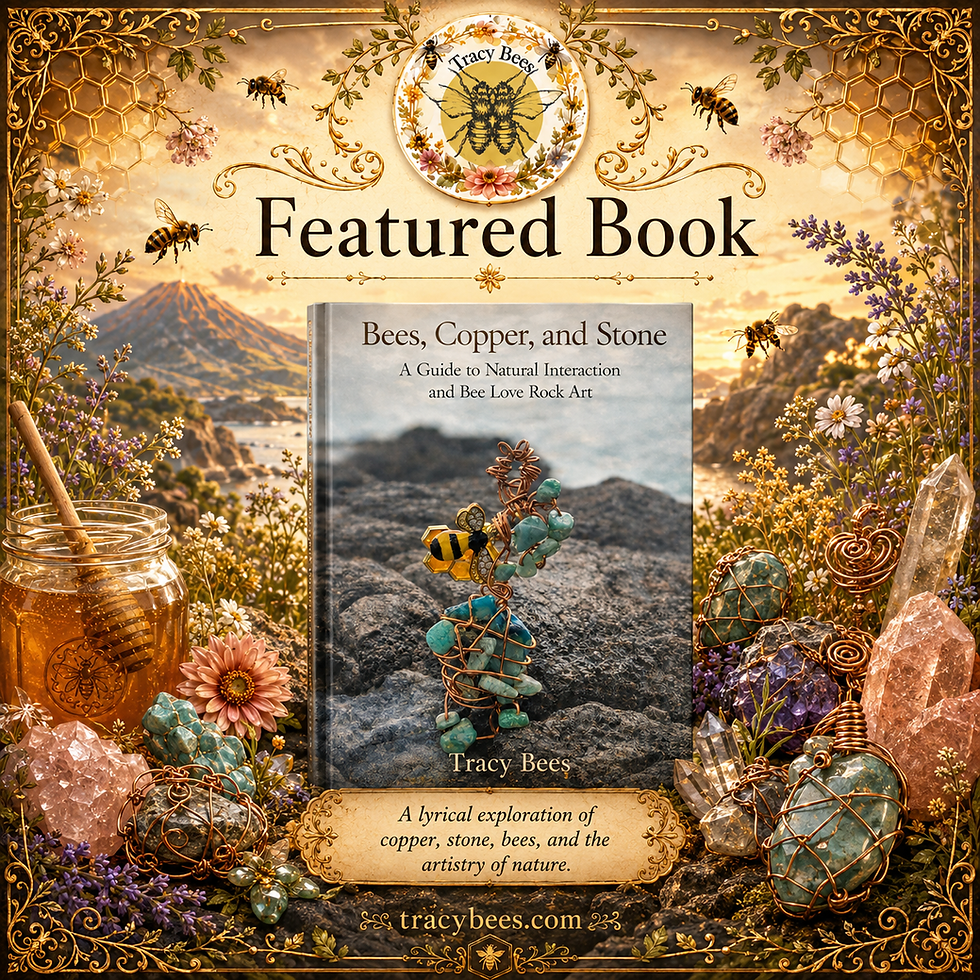
Bees, Copper, and Stone: A Guide to Natural Interaction and Bee Love Rock Art was created from that meeting place.
This Tracy Bees book is a contemplative journey into the relationships between the materials beneath our feet, the pollinators moving through our landscapes, and the human creativity inspired by both.
It invites us to look more closely.
To notice texture.
To notice color.
To notice the remarkable systems of life operating around us every day.
And perhaps most importantly, to recognize that nature does not exist as a collection of isolated pieces. Flowers, bees, soil, stone, water, minerals, climate, habitat, and human stewardship are all part of a much larger living story.
Guardians of the Natural World

At Tracy Bees, we often return to one guiding idea:
We are guardians of the natural world.
Bees are among the most extraordinary reminders of how deeply connected life on Earth really is.
A bee visiting a flower may appear to be a tiny moment, but that movement connects plants, food systems, wildlife, landscapes, farms, gardens, and people.
Pollinators help flowering plants reproduce, and those plants become part of wider ecosystems that provide food and habitat for countless other forms of life.
When we begin paying attention to bees, we often begin paying attention to everything around them as well.
The flowers.
The soil.
The seasons.
The water.
The trees.
The places where bees can nest, rest, forage, and thrive.
That awareness is at the heart of Tracy Bees.
We do not simply look at bees as producers of honey.
We see them as extraordinary members of living ecosystems and as beautiful invitations to become more observant, responsible, and connected to the natural world.
The Quiet Intelligence of Nature

Nature communicates in patterns.
Some are enormous: changing seasons, volcanic landscapes, oceans, forests, migrations, and weather.
Others are almost invisible unless we intentionally look for them.
The repeating geometry of honeycomb.
The arrangement of petals around a flower.
The mineral structure inside a stone.
The tiny hairs on a bee's body that collect pollen.
The flight path of a forager returning to the hive.
The slow weathering of rock into soil.
The natural world contains an extraordinary amount of information.
Bees, Copper, and Stone encourages readers to slow down enough to notice it.
That does not require us to assign a mystical explanation to every natural material we encounter. The beauty of nature is already extraordinary when we understand what it actually is.
Copper is an element.
Minerals are naturally occurring substances with distinct structures and properties.
Volcanic rocks tell stories about geological processes.
Flowers communicate with pollinators through color, scent, shape, nectar, and other biological signals.
And bees possess sophisticated sensory abilities that allow them to navigate an environment filled with light, odor, texture, landmarks, magnetic information, and floral cues.
The more closely we study the natural world, the more remarkable it becomes.
Pollinators and Place

A bee does not live separately from its environment.
The quality of a pollinator's life is deeply influenced by the landscape surrounding it.
Flower diversity matters.
Seasonal bloom times matter.
Nesting habitat matters.
Access to clean water matters.
The use — or avoidance — of harmful pesticides matters.
Even small areas of suitable habitat can become important resources for pollinators moving through developed environments.
A garden filled with different flowering plants can provide nectar and pollen across multiple seasons. Undisturbed patches of soil can support ground-nesting native bees.
Hollow stems and natural cavities can become nesting places for other species.
Healthy landscapes offer bees choices.
And diversity creates resilience.
This is one of the reasons Tracy Bees places such a strong emphasis on understanding bees within the larger ecosystem rather than seeing the hive alone.
To care for bees, we must also care for the places bees depend upon.
Volcanic Landscapes: Where Stone, Flower, and Pollinator Meet

Volcanic landscapes can appear dramatic, rugged, and even inhospitable.
Yet life finds astonishing ways to return.
Rock slowly weathers.
Organic material accumulates.
Plants establish themselves.
Flowers emerge.
Pollinators arrive.
Over time, what once appeared barren can become part of an intricate living system.
These landscapes are especially meaningful within the visual world of Bees, Copper, and Stone.
Dark volcanic rock creates a striking contrast against delicate flowers, golden bees, turquoise-colored stones, and warm copper.
But the connection is deeper than aesthetics.
Geology influences soil.
Soil influences vegetation.
Vegetation influences pollinator communities.
And pollinators contribute to the reproduction of flowering plants.
The stone beneath a landscape may therefore be part of a much longer ecological story than we immediately recognize.
Stones and Minerals: The Memory of the Land

Minerals and stones are among Earth's oldest storytellers.
Their colors, textures, fractures, crystals, and layers reveal evidence of geological processes unfolding across enormous spans of time.
Labradorite may flash with iridescent color as light interacts with its internal structure.
Rose quartz carries its characteristic soft pink hues.
Amethyst displays shades of violet created within crystalline quartz.
Turquoise is instantly recognizable for its beautiful blue-green coloration.
Obsidian forms when certain kinds of volcanic lava cool rapidly enough to create natural volcanic glass.
Lava rock preserves the textures of eruptions that once reshaped entire landscapes.
These materials do not need exaggerated claims to be extraordinary.
Their geology is extraordinary.
Their age is extraordinary.
Their natural variation is extraordinary.
And when incorporated thoughtfully into art, they can become beautiful reminders of the landscapes from which natural materials originate.
In Bee Love Rock Art, the stones are not meant to replace nature.
They are meant to celebrate it.
Bees, Minerals, and the Environment
Bees do not seek gemstones in the way they seek nectar, pollen, water, nesting materials, or other biological resources.
However, minerals are still part of the environments in which bees live.
Geology helps shape soils.
Soil chemistry influences plant communities.
Plants determine much of the food available to pollinators.
Water moving through rock and soil carries dissolved minerals.
And the physical structure of a landscape influences what kinds of plants, nesting sites, and habitats can develop there.
So the relationship between bees and stone is best understood as part of a larger ecological system.
It is not simply bee + mineral.
It is:
rock → soil → plants → flowers → pollinators → ecosystem.
That interconnectedness is one of the central ideas explored throughout Bees, Copper, and Stone
Bee Love Rock Art

Bee Love Rock Art grew from a love of bees, natural materials, color, landscape, and handmade creation.
Copper wire curves around stones.
Bee details appear among crystals and mineral textures.
Volcanic rock becomes a dramatic natural backdrop.
Turquoise, rose quartz, amethyst, clear crystals, and other stones bring color and individuality to each composition.
No two natural stones are exactly alike.
Their variations are part of their beauty.
Bee Love Rock Art uses those differences rather than attempting to erase them.
The result is artwork inspired by the natural world pieces that can serve as jewelry, keepsakes, gifts, conversation pieces, or simply small reminders to remain connected to nature.
The bee remains at the heart of the story.
Not merely as decoration, but as a symbol of the pollinators and ecosystems that inspire Tracy Bees.
Handcrafted With Earth's Gifts

Handcrafting changes the relationship between the maker and the material.
Instead of producing thousands of identical objects, handmade work requires attention to the individual piece.
One stone may be rounded.
Another may be crystalline.
Another may contain unusual coloration or texture.
Copper wire must move around those natural differences.
The design develops around the material rather than forcing every material into exactly the same form.
That slower process reflects an important idea found throughout Bees, Copper, and Stone:
Pay attention to what is already there.
Nature rarely produces perfect repetition.
A flower may open differently from the one beside it.
Two bees from the same colony are not identical.
Two stones collected from the same geological formation may look completely different.
Variation is not a flaw in nature.
Variation is one of nature's signatures.
Art, Earth, and Ecosystem

Art can become another way of learning to see.
A person who begins studying stones may become curious about geology.
Someone photographing bees may begin learning about native flowers.
A gardener planting for pollinators may begin noticing seasonal bloom cycles.
A child fascinated by honeycomb may eventually discover bee communication, navigation, colony structure, and pollination.
Curiosity often begins with something beautiful.
That is why art has an important place within environmental education.
It can open the door.
From there, science provides deeper understanding.
Observation creates connection.
And connection can grow into stewardship.
Bees, Copper, and Stone lives within that space where natural history, art, reflection, and ecological awareness meet.
The Beauty of Slower Observation
Modern life encourages us to move quickly.
Nature often rewards the opposite.
Sit beside a flowering plant for ten minutes and watch how many insects arrive.
Look closely at a stone instead of walking past it.
Watch how sunlight changes the appearance of copper.
Notice which flowers bees visit repeatedly.
Look at the structure of a leaf.
Observe the difference between one bee and another.
Listen to the sounds surrounding a garden.
There is an entire world operating beneath the speed of ordinary human attention.
Sometimes learning about nature begins with something remarkably simple:
staying long enough to notice.
About Bees, Copper, and Stone
Bees, Copper, and Stone: A Guide to Natural Interaction and Bee Love Rock Art is a reflective exploration of the places where ecology, artistry, natural materials, pollinators, and landscape come together.
It was created for readers who love bees, gardening, geology, minerals, handmade art, natural history, beautiful landscapes, and thoughtful connections between people and the living world.
Whether you arrive through an interest in bees, stones, copper, art, or nature itself, the invitation is the same:
Look closer.
Learn more.
Create thoughtfully.
And protect what makes this extraordinary planet alive.
Explore the Tracy Bees Library

The world of Tracy Bees extends far beyond a single book.
The Tracy Bees Library brings together books devoted to bees, pollinators, natural living, stewardship, education, wellness, and the remarkable intelligence of the hive.
Each book explores another doorway into the natural world from the lives and roles of bees to ethical beekeeping, honey, pollinator awareness, and the relationships connecting people with the environments around them.
If Bees, Copper, and Stone inspires your curiosity, continue exploring the Tracy Bees Library and discover another story from the hive.
Explore.
Learn.
Protect.
Share.
Visit Tracy Bees

Tracy Bees is a growing world of bee education, books, nature-inspired art, Bee Love Rock Art, environmental storytelling, and resources created to help people see pollinators differently.
Visit www.tracybees.com to explore the books, discover Bee Love Rock Art, learn more about our story, read additional articles, and continue discovering the extraordinary world of bees.
At Tracy Bees, we believe protecting pollinators begins with understanding them.
And sometimes understanding begins with something as simple as wonder.
The Bees Keep Us.
Guardians of the Natural World.
Thank you for spending time with us and for exploring the remarkable connections between bees, copper, stone, art, landscape, and life.
Every person who learns more about pollinators becomes another person capable of noticing them, appreciating them, and helping protect the environments they call home.
From all of us at Tracy Bees, thank you for being part of this journey.


Comments